Have a software and mobile app development project in mind? Here are some of the blogs that will offer valuable insights when you are planning to hire a software and mobile app development company for your dream project.
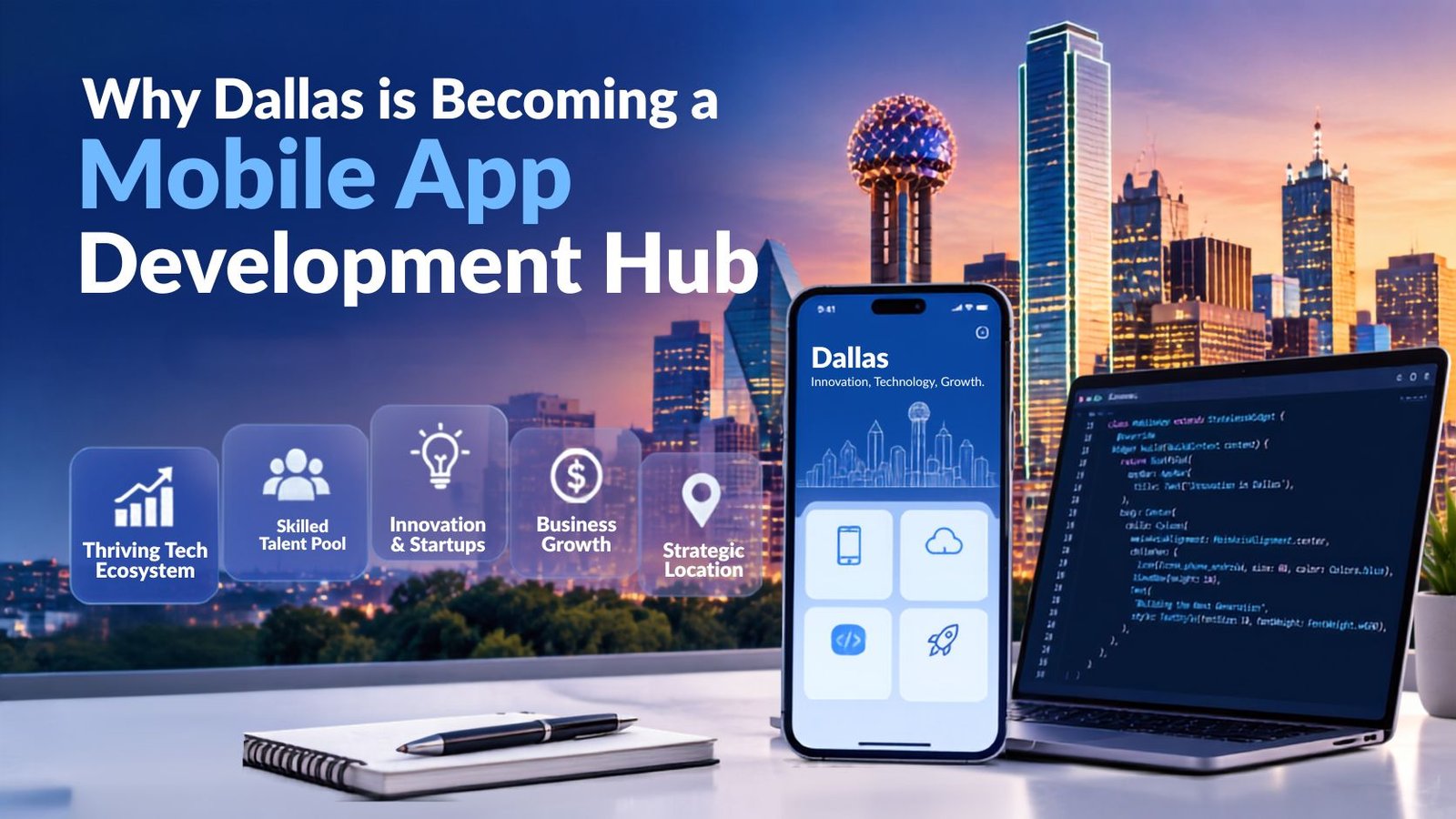
Dallas has quietly become one of the most exciting places for technology innovation in the United States. Once recognized primarily for its strong telecommunications and energy sectors, the city has evolved into a thriving ecosystem where startups, mid-sized businesses, and Fortune 500 companies are building next-generation digital products.
The shift isn't happening by chance. Businesses across Dallas are adopting digital transformation faster than ever, investing in cloud technologies, artificial intelligence, automation, and mobile applications to improve customer experiences and streamline operations. As consumers increasingly expect businesses to offer fast, personalized, and mobile-first experiences, organizations that delay digital adoption risk losing market share to more agile competitors.
Mobile applications are now central to this transformation. Whether it's enabling field employees to work more efficiently, simplifying customer interactions, automating business processes, or launching entirely new digital services, mobile apps have become strategic business assets rather than optional investments.
This growing demand has also increased the need for experienced development partners. Today, businesses looking for a reliable mobile app development company in Dallas aren't simply searching for developers, they're looking for technology experts who understand product strategy, scalability, security, and long-term business growth.
In this guide, we'll explore why Dallas has emerged as one of America's fastest-growing technology hubs, why organizations across industries are accelerating mobile app investments, and what decision-makers should know before choosing the right development partner.
Dallas has become far more than a regional business center. It now ranks among the most attractive cities for launching startups, expanding enterprise operations, and developing innovative digital products. Companies relocating to Texas often choose Dallas because it combines business advantages with access to talent, infrastructure, and a rapidly growing technology ecosystem.
Unlike many established tech markets, Dallas offers room for businesses to scale without facing the extremely high operational costs associated with traditional technology hubs. Organizations can hire skilled professionals, collaborate with experienced technology partners, and expand their operations while maintaining healthier budgets.
For startups, this means more runway to innovate before seeking additional funding. For established enterprises, it creates opportunities to modernize legacy systems, accelerate digital initiatives, and experiment with emerging technologies while maintaining operational efficiency.
The city's strong economy also encourages collaboration across industries. Healthcare providers, logistics companies, manufacturers, financial institutions, retailers, and real estate firms frequently partner with technology companies to solve industry-specific challenges through custom software and mobile applications.
As a result, Dallas continues attracting entrepreneurs, investors, software engineers, and product innovators who are shaping the next generation of digital businesses.
Dallas has steadily transformed into one of America's most influential technology markets. A combination of economic growth, infrastructure, skilled professionals, and business-friendly policies has created an environment where innovation thrives.
Instead of relying on a single industry, Dallas benefits from a diverse business ecosystem that continuously creates opportunities for technology adoption and digital transformation.
One of Dallas' biggest competitive advantages is its welcoming business climate.
Texas has long attracted companies looking to reduce operational costs while maintaining access to a large customer base and strong transportation networks. Businesses relocating from higher-cost regions often find Dallas to be an ideal destination for establishing headquarters, opening regional offices, or expanding technology operations.
The city's supportive economic environment enables organizations to invest more confidently in innovation, research, and product development rather than allocating excessive resources toward operating expenses.
This business-friendly atmosphere has also encouraged venture capital investment, startup growth, and increased demand for digital products across virtually every industry.
For technology companies, these conditions create a healthy environment where ideas move from concept to market much faster.
Technology innovation depends on people, and Dallas offers access to one of the country's strongest talent pools.
The region benefits from graduates entering the workforce from respected universities while also attracting experienced professionals relocating from across the United States. Engineers, product managers, UI/UX designers, cloud architects, AI specialists, and cybersecurity experts contribute to an increasingly mature technology ecosystem.
This steady availability of skilled professionals allows businesses to build high-performing development teams without facing the same talent shortages experienced in many other major technology markets.
Many organizations also choose to hire mobile app developers through specialized development companies, enabling them to access multidisciplinary teams that include business analysts, designers, developers, QA engineers, DevOps specialists, and project managers under one roof.
The result is faster product development with reduced hiring complexity and greater technical expertise.
Unlike cities where technology growth depends heavily on one sector, Dallas benefits from innovation across multiple industries.
Because businesses across so many industries face unique operational challenges, technology companies gain valuable experience solving complex real-world problems instead of developing one-size-fits-all software.
This diversity accelerates innovation while encouraging the adoption of emerging technologies such as artificial intelligence, cloud computing, predictive analytics, automation, and connected devices.
The role of mobile applications has changed dramatically over the past decade.
Initially viewed as customer convenience tools, mobile apps have evolved into critical business platforms that improve productivity, automate workflows, increase revenue, and strengthen customer relationships.
Today, organizations across Dallas recognize that digital experiences often define how customers perceive their brand.
Here are the major reasons businesses continue increasing their investments in mobile app development.
Modern customers expect businesses to be available wherever they are.
Whether scheduling appointments, placing orders, requesting services, making payments, or accessing support, users increasingly prefer mobile experiences that are fast, intuitive, and available around the clock.
Organizations that continue relying solely on websites or traditional communication channels often struggle to meet these expectations.
Well-designed mobile applications create seamless customer journeys through personalized experiences, real-time notifications, secure payments, self-service capabilities, and instant communication.
For many businesses, mobile apps have become the primary channel for customer engagement rather than an additional digital offering.
Mobile applications aren't only designed for customers.
Many Dallas organizations are building internal business applications that improve everyday operations across departments.
Replacing manual processes with mobile workflows reduces paperwork, minimizes human error, improves visibility, and accelerates decision-making across the organization.
The productivity improvements often extend well beyond the initial investment.
Work is no longer confined to office desks.
Employees increasingly work across construction sites, healthcare facilities, warehouses, retail locations, manufacturing plants, and client offices.
Businesses require secure mobile applications that provide employees with access to essential systems regardless of location.
Mobile workforce solutions enable staff to submit reports, communicate with teams, access documents, manage schedules, capture digital signatures, and complete business processes without returning to the office.
This flexibility improves employee productivity while helping organizations respond more quickly to customer needs.
Artificial intelligence is rapidly becoming part of everyday business operations, and mobile applications are among the most practical ways to deliver AI-powered experiences.
Organizations are integrating AI into their apps to automate repetitive tasks, provide intelligent recommendations, analyze user behavior, enhance customer support through conversational assistants, and generate predictive business insights.
Instead of treating AI as a separate initiative, businesses increasingly incorporate intelligent capabilities directly into mobile platforms where employees and customers interact daily.
This allows organizations to improve efficiency while creating smarter digital experiences that continuously evolve through data.
Many businesses are discovering entirely new revenue opportunities through mobile applications.
Rather than simply digitizing existing processes, organizations are creating entirely new business models powered by mobile technology.
This shift is enabling companies to serve customers more efficiently while opening additional channels for long-term growth.
Competition continues increasing across nearly every industry in Dallas. Businesses can no longer rely solely on pricing or traditional customer service to differentiate themselves. Digital experience has become a major competitive advantage.
Companies working with experienced mobile app developers in Dallas are creating applications that deliver faster service, personalized recommendations, seamless integrations, real-time communication, and better user experiences than their competitors.
These advantages improve customer satisfaction while strengthening brand loyalty and increasing long-term business value.
Scale your team faster with pre-vetted, dedicated developers from iQlance. Whether you need web, mobile, AI, or software experts, our USA-focused hiring model helps you launch projects quickly while reducing recruitment time and costs.
Hire Dedicated Developers TodayBusinesses across Dallas are no longer investing in mobile apps simply to establish a digital presence. Today's applications solve operational challenges, improve customer engagement, automate workflows, and create entirely new revenue opportunities. As technology continues to evolve, organizations are selecting development approaches based on business goals, scalability, speed to market, and long-term maintenance rather than following a one-size-fits-all strategy.
Whether you're launching a startup, modernizing an enterprise system, or expanding digital services, understanding the different types of mobile app development can help you choose the right solution for your business.
React Native remains one of the most popular frameworks for businesses looking to build applications for both iOS and Android using a shared codebase. It allows organizations to accelerate development without sacrificing user experience, making it an attractive choice for startups and established companies alike.
Dallas businesses often choose react native app development for customer-facing applications, eCommerce platforms, booking systems, loyalty programs, and internal business tools that require consistent functionality across multiple devices.
Beyond reducing development time, React Native offers easier maintenance, faster feature releases, and access to a large developer ecosystem. This makes it ideal for companies that want to scale quickly while keeping development costs under control.
Flutter has gained significant momentum because of its ability to deliver visually appealing, high-performance applications across multiple platforms from a single codebase.
Companies building consumer apps, healthcare platforms, education solutions, fintech products, and interactive business applications often choose Flutter for its rich user interface capabilities and near-native performance.
For organizations that prioritize user experience and modern design, Flutter enables developers to create highly responsive applications while reducing the effort required to support different operating systems.
Its flexibility also allows businesses to adapt quickly as customer expectations evolve and new features need to be introduced.
Not every great product begins with a fully featured application.
Many Dallas startups and innovation-driven enterprises first launch an MVP app development to validate their ideas before making larger investments. Instead of building every possible feature, an MVP focuses on solving one core business problem exceptionally well.
This approach helps organizations:
Launching an MVP also shortens time-to-market, allowing businesses to refine their products through continuous improvements rather than relying on assumptions during development.
Artificial intelligence has moved beyond experimentation and is becoming a standard feature in modern mobile applications.
Dallas organizations are integrating AI to create smarter, more efficient user experiences. Depending on the industry, AI can power intelligent search, personalized recommendations, automated customer support, predictive analytics, image recognition, voice interactions, fraud detection, and workflow automation.
Instead of replacing human decision-making, AI enhances productivity by helping users complete tasks faster and enabling businesses to deliver more personalized digital experiences.
As AI technologies continue advancing, organizations that invest early gain valuable insights while improving customer satisfaction and operational efficiency.
For businesses looking to maximize reach while optimizing development resources, cross-platform app development has become an increasingly practical solution.
Rather than maintaining separate development teams for iOS and Android, companies can build a unified application that serves users across multiple operating systems.
Cross-platform development offers several advantages, including:
Many businesses comparing Dallas mobile app development companies consider cross-platform expertise an important factor, particularly when launching products within tight budgets or aggressive timelines.
While cross-platform frameworks continue gaining popularity, native development remains the preferred choice for applications requiring maximum performance, advanced device capabilities, or highly specialized functionality.
Native applications are developed specifically for each operating system using platform-specific programming languages and tools.
Organizations typically choose native development when building:
Although native development requires greater investment, it delivers exceptional performance, stronger security, and deeper integration with device capabilities.
Enterprise mobility has become essential for organizations managing complex operations across multiple departments, locations, and teams.
Rather than focusing solely on customer engagement, enterprise applications improve internal productivity by connecting employees with business systems wherever they work.
Common enterprise applications include:
These solutions integrate with ERP, CRM, cloud platforms, and other enterprise systems to create connected digital workflows that improve operational visibility and efficiency.
Many organizations still rely on legacy applications that no longer meet modern business requirements.
Instead of replacing existing systems entirely, businesses are increasingly modernizing their applications by upgrading technology stacks, redesigning user experiences, migrating infrastructure to the cloud, and integrating modern APIs.
Application modernization helps businesses:
For companies undergoing digital transformation, modernization often delivers greater long-term value than continuing to maintain outdated software.
Launching an application is only the beginning of its lifecycle.
Successful businesses continuously improve their apps based on user feedback, performance metrics, operating system updates, and changing market demands.
Ongoing maintenance typically includes:
Organizations that invest in continuous optimization maintain higher user satisfaction while ensuring their applications remain secure, reliable, and competitive.
Dallas has developed one of the country's most diverse business ecosystems, creating opportunities for mobile innovation across numerous industries. Rather than relying on a single sector, the city's economic diversity encourages businesses to solve unique challenges through custom mobile solutions.
This broad demand continues to fuel innovation while driving the adoption of emerging technologies such as AI, cloud computing, IoT, and automation.
Healthcare organizations are rapidly expanding digital care services beyond traditional clinical settings.
Hospitals, specialty clinics, telehealth providers, and healthcare startups are investing in secure mobile applications that improve patient engagement and operational efficiency.
Popular healthcare applications include:
With increasing emphasis on convenience and accessibility, mobile technology has become an essential part of modern healthcare delivery.
Dallas serves as one of America's largest transportation and logistics hubs, making mobile technology indispensable for supply chain operations.
Logistics companies rely on mobile applications to improve shipment visibility, optimize delivery routes, monitor fleets, and enhance communication between dispatchers and drivers.
These solutions enable businesses to reduce delays, improve customer satisfaction, and make faster operational decisions using real-time data.
Consumer expectations continue reshaping the retail industry.
Today's shoppers expect personalized recommendations, fast checkout experiences, loyalty rewards, and real-time order tracking directly from their smartphones.
Retailers are responding by investing in mobile commerce applications that combine convenience with personalized customer experiences, helping brands strengthen engagement while increasing customer retention.
Financial institutions and fintech startups continue accelerating digital innovation through secure mobile applications.
Modern fintech apps now support:
As customer expectations for secure and seamless financial services continue growing, mobile applications remain central to digital banking strategies.
Manufacturers across Dallas are using Industry 4.0 technologies to improve operational efficiency.
Mobile applications now connect factory operations with real-time production monitoring, equipment maintenance, inventory management, quality inspections, and workforce collaboration.
These connected systems provide better visibility while enabling faster decision-making throughout manufacturing operations.
Real estate professionals increasingly depend on mobile applications to simplify property discovery and client communication.
Applications commonly include:
These digital experiences improve responsiveness while helping buyers, sellers, and agents complete transactions more efficiently.
Educational institutions and EdTech companies continue expanding digital learning experiences through mobile applications.
Learning platforms now offer:
As hybrid education models continue evolving, mobile applications play an increasingly important role in delivering accessible and engaging learning environments.
Choosing the right development partner involves much more than technical expertise. Businesses also benefit from working with teams that understand their market, industry, and long-term objectives.
While remote development has become common, partnering with a local team often creates stronger collaboration throughout the product lifecycle.
Local development partners can work more closely with your leadership team during planning, product discovery, and strategic decision-making. Face-to-face meetings, collaborative workshops, and ongoing discussions often lead to faster alignment and fewer misunderstandings.
A local development team has greater familiarity with the industries driving the regional economy, customer expectations, and competitive landscape. This understanding helps shape products that address real business challenges rather than relying on generic solutions.
Successful mobile app development depends on consistent communication. Working within similar business hours simplifies project discussions, sprint reviews, feedback sessions, and decision-making, allowing issues to be resolved more quickly.
The discovery phase lays the foundation for a successful product. Local collaboration makes it easier to conduct stakeholder workshops, define business requirements, map user journeys, and validate product ideas before development begins.
A mobile application should continue evolving after launch. Businesses often rely on the same technology partner for future enhancements, new integrations, scaling initiatives, and ongoing support. Establishing a long-term relationship with a trusted development team ensures continuity as your business grows.
Choosing a mobile app development partner is a strategic business decision, not simply a hiring exercise. The right team will help you validate ideas, reduce development risks, build scalable technology, and support your product long after launch. On the other hand, selecting the wrong partner can lead to missed deadlines, budget overruns, technical debt, and poor user adoption.
Before you hire mobile app developers, evaluate potential partners using the following criteria.
Our Dallas-based team has helped startups and enterprises launch scalable iOS and Android applications. Let's discuss your project and timeline.
Request Your Quote TodayEvery industry comes with unique workflows, compliance requirements, customer expectations, and operational challenges. A development team that understands your business domain can recommend practical solutions instead of spending valuable project time learning industry basics.
For example:
Review the company's previous projects and ask whether they have built similar solutions for businesses in your industry.
Successful applications begin long before coding starts.
A professional development company invests time in understanding your business goals, target audience, technical requirements, and long-term vision through a structured discovery phase.
This typically includes:
A thorough discovery process minimizes uncertainty, prevents scope creep, and ensures everyone is aligned before development begins.
Writing code is only one part of building a successful mobile application.
An experienced development partner should also help you answer critical business questions such as:
A strategic approach helps businesses invest in features that solve real customer problems instead of building unnecessary functionality.
An application's success depends heavily on user experience.
Even technically advanced software can struggle if users find it confusing or difficult to navigate.
Look for a team that prioritizes:
Exceptional user experience increases customer satisfaction, engagement, and retention while reducing support requests.
Artificial intelligence is becoming a competitive advantage across nearly every industry.
Rather than asking whether a company offers AI development, ask how they evaluate opportunities to integrate AI into your product where it creates measurable business value.
Examples include:
A forward-thinking development partner should help you identify practical AI use cases that align with your business objectives.
Security should be integrated into every stage of development, not added after launch.
Ask prospective development partners how they approach:
Organizations handling financial, healthcare, or customer data should ensure their application is designed with security and compliance in mind from day one.
Your application should be able to support future growth without requiring a complete rebuild.
Discuss how the architecture will handle:
Scalable architecture protects your investment while allowing the product to evolve alongside your business.
Launching your app is only the beginning.
Operating system updates, changing customer expectations, security enhancements, and business growth require continuous improvements.
A reliable development partner should provide:
Long-term support ensures your application remains reliable, secure, and competitive.
A portfolio provides insight into a company's technical capabilities, design quality, and experience across industries.
When reviewing previous work, look beyond attractive interfaces and ask:
Real-world success stories often reveal far more than technical specifications alone.
Strong communication is one of the most overlooked factors in successful software projects.
Choose a development partner that provides:
Open communication builds trust, reduces misunderstandings, and keeps projects moving efficiently from discovery to deployment.
Mobile technology continues to evolve rapidly, and businesses that adopt emerging innovations are better positioned to improve customer experiences, streamline operations, and stay ahead of competitors.
Here are the trends expected to shape mobile app development across Dallas in the coming years.
Artificial intelligence is no longer an optional feature; it has become a core business capability.
Organizations are embedding AI into mobile applications to automate workflows, personalize customer interactions, improve search experiences, generate insights, and deliver intelligent recommendations.
From healthcare and finance to retail and logistics, AI-powered apps are helping businesses make faster, data-driven decisions while improving user engagement.
Businesses are moving beyond historical reporting to predictive decision-making.
Modern mobile applications analyze customer behavior, operational data, and historical trends to forecast outcomes before they occur.
Predictive analytics enables organizations to:
These insights help organizations become more proactive rather than reactive.
Connected devices continue transforming industries across Dallas.
Mobile applications increasingly communicate with sensors, vehicles, manufacturing equipment, healthcare devices, and smart building systems to provide real-time visibility and control.
IoT-enabled apps support use cases such as:
As connected ecosystems expand, mobile applications will remain the primary interface for managing IoT environments.
Wearables are extending mobile experiences beyond smartphones.
Businesses are developing applications for smartwatches, fitness trackers, medical devices, and industrial wearables that provide instant access to important information without requiring users to reach for their phones.
Industries such as healthcare, logistics, manufacturing, and fitness are already seeing significant value from wearable technology.
Generic digital experiences are becoming less effective.
Modern applications use customer behavior, preferences, purchase history, and AI-driven insights to deliver highly personalized content, recommendations, notifications, and offers.
Hyper-personalization improves user engagement by making every interaction more relevant to individual customers.
Cloud-native architecture allows businesses to build applications that are scalable, resilient, and easier to maintain.
Instead of relying on traditional infrastructure, cloud-native apps support:
As organizations continue modernizing their technology stacks, cloud-native development is becoming the preferred approach for building future-ready applications.
Businesses continue seeking faster ways to launch applications across multiple platforms without compromising quality.
Advancements in frameworks such as Flutter and React Native have significantly improved performance, making cross-platform development an attractive option for organizations that want to reduce development time while maintaining a consistent user experience.
This trend is expected to accelerate as companies prioritize faster time-to-market and efficient resource utilization.
Enterprise mobility is expanding beyond employee access to include intelligent automation.
Mobile applications now integrate with ERP systems, CRM platforms, cloud services, AI engines, and workflow automation tools to eliminate repetitive tasks and improve operational efficiency.
Businesses are using automation to:
Enterprise automation enables organizations to operate more efficiently while allowing employees to focus on higher-value work.
For businesses looking to innovate, scale, and compete in an increasingly digital economy, Dallas offers an ideal environment for mobile app development.
The city combines a thriving technology ecosystem with a strong business community, access to skilled talent, and innovation across industries including healthcare, logistics, manufacturing, finance, retail, and real estate. This combination creates opportunities for organizations to build products that solve real business challenges while supporting long-term growth.
Whether you're launching a startup, developing an enterprise platform, modernizing an existing application, or integrating AI into your digital strategy, partnering with experienced professionals can significantly improve your chances of success.
The key is to choose a development partner that understands your business objectives, follows a structured development process, and builds scalable solutions designed for future growth, not just today's requirements.
Dallas offers a business-friendly environment, a strong technology talent pool, and a diverse economy that encourages innovation across industries such as healthcare, logistics, finance, manufacturing, and retail. These factors make it an ideal location for building scalable mobile applications.
Look for a company with proven industry experience, a structured discovery process, strong UI/UX expertise, AI capabilities, scalable development practices, transparent communication, and ongoing post-launch support. Reviewing their portfolio and client success stories can also help you make an informed decision.
The right approach depends on your business goals. Native apps offer maximum performance and access to platform-specific features, while cross-platform development provides faster deployment and lower maintenance costs for businesses targeting both iOS and Android users.
App development costs vary depending on the project's complexity, features, integrations, design requirements, and technology stack. A simple MVP generally costs significantly less than a feature-rich enterprise application. A discovery workshop can provide a more accurate estimate.
Development timelines depend on project scope. An MVP may take a few months, while complex enterprise applications with advanced integrations and AI capabilities often require six months or longer.
Healthcare, logistics, retail, eCommerce, FinTech, manufacturing, real estate, and education are among the industries investing heavily in mobile technology to improve customer experiences and operational efficiency.
Yes. Many businesses enhance existing applications with AI-powered features such as intelligent chatbots, predictive analytics, recommendation engines, workflow automation, and personalized user experiences without rebuilding the entire application.
Working with local teams often provides better collaboration, easier communication, stronger market understanding, faster discovery workshops, and long-term strategic support throughout your product's lifecycle.