Have a software and mobile app development project in mind? Here are some of the blogs that will offer valuable insights when you are planning to hire a software and mobile app development company for your dream project.
Mobile apps are a major way to reach customers, run a business, and deliver services. As mobile app usage grows, businesses are strengthening their digital presence.
Worldwide, mobile app consumers spend a ton of money. In 2025, there were an estimated to be 106.9 billion downloads across the App Store and Google Play. Consumer spending rose 21.6% to $155.8 billion, while downloads fell 2.7% from a year ago. This offers a glimpse into the app's commercial value.
But a successful app takes more than a good idea. The app development framework is also critical to choose. It can impact time to market, app performance, and development cost. Here we will cover some popular frameworks and their types, so you can determine which one suits your business best.
An app development framework is a set of tools, libraries, and reusable components that assist developers in creating mobile apps. It offers a structured space in which to write code, design the interface, and add app functionality.
Developers can use existing components and development tools instead of designing everything from scratch. These include navigation systems, UI components, testing tools, and APIs. This minimizes repetitive coding and helps organize the development process.
Frameworks can also help organize an application. They ensure uniformity in code and simplify development of various sections of a project. Some frameworks are designed to build an application for a single platform (iOS or Android), while others support multiple platforms.
The choice of framework depends on the app's requirements, target audience, and technical needs. A proper structure will ease the development process, boost productivity, and make ongoing changes more manageable. It also provides businesses with a more structured way of creating and sustaining applications.
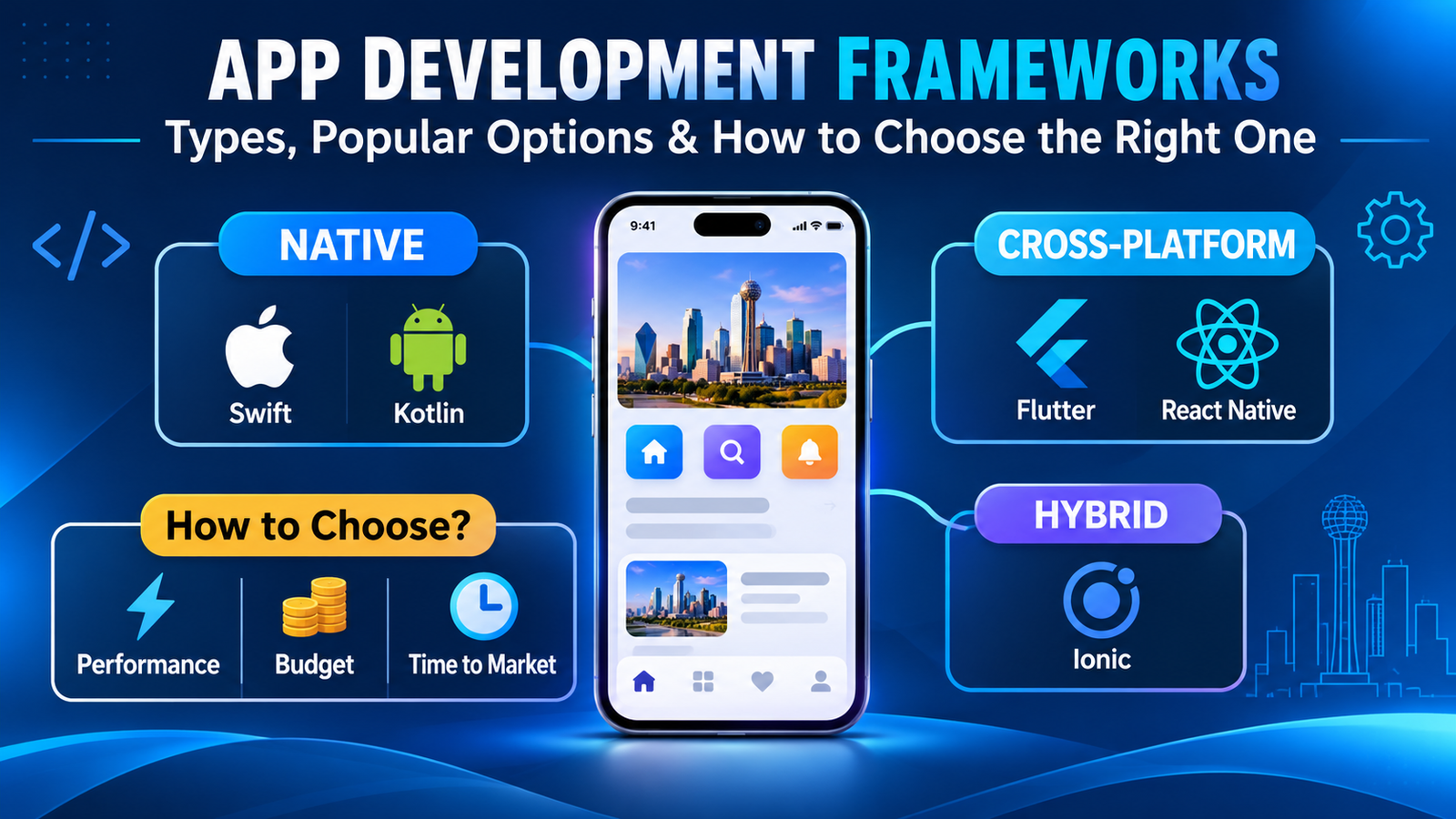
The three primary types of app development frameworks are native, cross-platform, and hybrid. All have different development styles. It depends on your budget, the platforms you are aiming at, and the app needs you have.
Native frameworks are designed for a specific platform, and in this case, Android or iOS. These apps are created with platform-specific languages and tools.
For iOS, the typical languages are Swift and SwiftUI. Kotlin and Jetpack Compose are used by Android developers. Native apps are powerful and have direct access to device capabilities.
They are ideal for applications that require more advanced capabilities or seamless use. But creating individual apps for each platform can be costly and time-consuming.
Cross-platform frameworks enable developers to create the same app for various operating systems. For example, Flutter and React Native.
Developers can share the same code for all different platforms. This will decrease development time and expenses. It also aids in the maintenance of apps.
This is ideal for startups and businesses that need to reach both Android and iOS users within a specific budget.
Hybrid frameworks integrate web technology and native apps. They use HTML, CSS, and JavaScript. They are used in Ionic, for instance.
These frameworks enable developers to leverage web code and skills. They are suitable for content-based apps and simpler projects.
But this may differ depending on app complexity and device needs.
Mobile applications can be developed in various frameworks and technologies. They have various features and functions. Here are five popular options businesses can consider.
Flutter is a free framework created by Google. It is written in the Dart programming language. A single codebase for building Android, iOS, web, and desktop applications.
Further, Flutter has the capability of hot reloading. This feature can be used to preview code changes before reloading the entire application. It features a rendering engine for consistent designs across platforms.
Flutter suits startups and businesses that desire to launch apps on various platforms. This can also help control development costs.
React Native is an open-source framework created by Meta. It is a JavaScript and React app builder for Android and iOS.
Developers can reuse much of the same code across platforms. They can also use the native device features.
It has a large developer community and is flexible with its reusability. For businesses seeking feature-packed apps without separate codebases, React Native is the ideal choice.
Ionic is a free, open-source web technologies-based framework. It builds mobile applications across all platforms using HTML, CSS, and JavaScript.
Provides pre-designed UI elements. It supports tools such as Angular, React, and Vue too.
Ionic suit-based apps, business tools, and projects that require uniform interfaces across platforms. It also aids teams in reusing web development skills.
Swift is Apple's programming language for creating apps for all platforms. SwiftUI is a UI framework to create native interfaces using Swift.
They complement each other in the development of iOS applications. Developers will only be able to create native apps using Apple-specific features and tools.
These technologies are good for businesses targeting iPhone users. They are also suitable for apps that depend on Apple.
Kotlin is a modern programming language, widely used for developing Android apps. Jetpack Compose is a UI toolkit developed by Google to create native Android UI.
It uses a declarative approach to simplify UI development. Developers can develop responsive layouts with less code.
This is a fit for companies that develop Android applications. It supports native performance and Android features.
Choosing the right mobile app development framework depends on your audience, budget, and app needs.
A proper structure can make app development more organized and efficient. It also aids businesses with development resources and future improvements. Here are some highlights.
A framework offers pre-made components, libraries, and development tools. These resources can replace the development of all features. This can help to decrease development time and facilitate quicker product launches.
Reusable code and built-in tools can help minimize repetitive development work. Migrating to multiple platforms with a shared code base can also save businesses money. This is especially helpful for startups who are on a budget.
Frameworks offer users ready-to-use UI elements and design tools. These help establish consistent appearance and uniformity across different screens and devices. They are also more user-friendly, with a familiar interface across applications.
Changes, features, and fault finding will be easier due to a structured codebase. It is also possible to add new functionality as per the business requirements. A top-quality App Development Framework can help in future enhancements and long-term maintenance.
Choosing a framework means more than just comparing popular technologies! Companies must evaluate their application needs, resources, and plans. The following factors can aid the decision.
The first step is to know what you need your application to do. Consider its core features, customers, and complexity. A basic business app doesn't have to be as technologically sophisticated as an app with advanced integrations or real-time functionality.
Development time and delivery time could vary between frameworks. You may need separate teams for iOS and Android native development. Shared code can reduce duplicate work across platforms. Choose a method that fits your budget and has the required features.
Identify your target audience's media platforms. If you are looking to reach both Android and iOS users, you need a framework that has both. If your app is platform-specific, native development may suit your needs better.
Think about the app as it develops and expands. Applications with complex animation, processing, or advanced device integrations may have specific performance requirements. Select technology that will meet these requirements.
Look for seasoned developers for your preferred technology. Also consider documentation, community support, updates, and long-term support. A strong supporting framework can make future improvements easier.
You need the right App Development Framework to meet your business needs now and in the future. Don't just choose what's popular; consider all practical factors.
Hiring a development partner is crucial to building a successful application. Look beyond pricing. Prioritize skills, project experience, and communication.
Consider these factors before making a decision:
Technical Expertise: Review the team's experience with various frameworks and technologies. Ensure they meet your project specifications.
Portfolio and Experience: Review previous projects. Check for pertinent industry experience and work.
Communication: Ensure the team shares regular updates. Establishing definite timeframes and communication helps prevent delays.
Knowledge of Business Objectives: A team with knowledge of your target audience, budget, and business goals.
As you compare App Development Dallas services, don't just consider the price. Review the team's strategy, technical ability, and team support. The right partner should be able to bring your idea to fruition.
The selection of an app development framework can impact the application's functionality, development expenses, and future scalability. Both choices have their pros and cons. The ideal option will be determined by your project needs, platforms, budget, and scope.
Before deciding, compare the available technologies and consider which best fits your business. But with the help of an experienced development partner, you can figure out your options and plan it right.
We at Mobile App Development Company Dallas can assist businesses in transforming their app ideas into reality. Contact us now.
An App Development Framework is a collection of tools, libraries, and components. It can assist developers in writing less repetitive code with a structured approach.
Flutter and React Native are popular options for new startups. They both support both the iOS and Android platforms with a shared codebase. This depends on your project needs and the skills of your team.
Both of these frameworks have advantages. Flutter provides user interface components that you can customize and uniform rendering. React Native is based on native UI components and it's compatible with JavaScript and React. It will depend on the requirements of your app.
Native applications are developed to run on a particular operating system. Cross-platform frameworks: Applications can be developed using the same code across multiple platforms.
App Development Costs vary with the features, design, integrations, and complexity. An app that is simple can be cheaper than an app that has specialized features. A detailed project assessment helps estimate the budget.